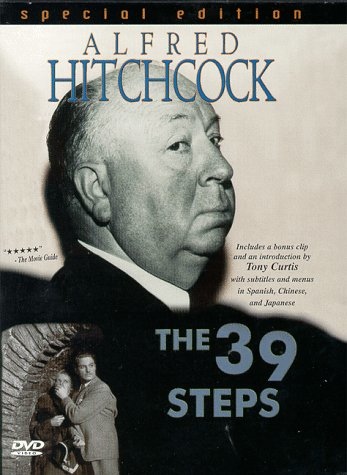
Director: Alfred Hitchcock
Starring: Peggy Ashcroft, Ivor Barnard, Wilfrid Brambell, Madeleine Carroll, Frank Cellier
Genre: Art House & International
Studio: Delta Theatrical: 1935 Rated:
Unrated
Languages (Country): English ()
Summary: Hitchcock's first great romantic thriller is a prime example of the MacGuffin principle in action. Robert Donat is Richard Hannay, an affable Canadian tourist in London who becomes embroiled in a deadly conspiracy when a mysterious spy winds up murdered in Hannay's rented flat--and both the police and a secret organization wind up hot on his trail. With only a seemingly meaningless phrase ("the 39 steps"), a small Scottish town circled on a map, and a criminal mastermind identified by a missing finger as clues, quick-witted Hannay eludes police and spies alike as he works his way across the countryside to reveal the mystery and clear his name. At one point he finds himself making his escape manacled to blonde beauty Pamela (Madeleine Carroll), whose initial antagonism is smoothed by Hannay's charm and the sheer rush of her thrilling chase. It's classic Hitchcock all the way, a seemingly effortless balance of romance and adventure set against a picturesque landscape populated by eccentrics and social-register smoothies, none of whom is what he or she appears to be. Hitchcock would play similar games of innocents plunged into deadly conspiracies, most delightfully in "North by Northwest", but in this breezy 1935 classic, Hitch proves that, as in any quest, the object of the search isn't nearly as satisfying as the journey. "--Sean Axmaker"

Director: Wim Wenders
Starring: Compay Segundo, Ibrahim Ferrer, Rubén González, Eliades Ochoa, Ry Cooder
Genre: Art House & International
Studio: Lions Gate Theatrical: 1999 Rated:
G
Languages (Country): Spanish ()
Summary: In 1996, composer, producer, and guitar legend Ry Cooder entered Egrem Studios in Havana with the forgotten greats of Cuban music, many of them in their 60s and 70s, some of them long since retired. The resulting album, "Buena Vista Social Club", became a Grammy-winning international bestseller. When Cooder returned to Havana in 1998 to record a solo album by 72-year-old vocalist Ibrahim Ferrer, filmmaker Wim Wenders was on hand to document the occasion. Wenders splits the film between portraits of the performers, who tell their stories directly to the camera as they wander the streets and neighborhoods of Havana, and a celebration of the music heard in performance scenes in the studio, in their first concert in Amsterdam, and in their second and final concert at Carnegie Hall. The songs are too often cut short in this fashion, but "Buena Vista Social Club" is not a concert film. Wenders weaves the artist biographies with a glimpse of modern Cuba remembering its past, capturing a lost culture in music that is suddenly, unexpectedly revived for audiences in Havana and around the world. Wenders makes his presence practically invisible, as if his directorial flourishes or off-screen narration might deflect attention from the artists, who do a fine job of telling their own stories through interviews and music. It's a loving portrait of a master class in Cuban music, with a vital cast of aging performers whose energy and passion belie their years. "--Sean Axmaker"

Director: Neil Jordan
Starring: Stephen Rea, Jaye Davidson, Forest Whitaker, Miranda Richardson, Adrian Dunbar
Genre: Art House & International
Studio: Live / Artisan Theatrical: 1992 Rated:
R
Languages (Country): English ()
Summary: "The Crying Game" offers a rare and precious movie experience. The film is an unclassifiable original that surprises, intrigues, confounds, and delights you with its freshness, humor, and honesty from beginning to end. It starts as a psychological thriller, as IRA foot soldier Fergus (the incomparable Stephen Rea) kidnaps a British soldier (Forest Whitaker) and waits for the news that will determine whether he executes his victim or sets him free. As the night wears on, a peculiar bond begins to form between the two men. Later, the movie shifts tone and morphs into something of a romantic comedy as Fergus unexpectedly becomes involved with the soldier's girlfriend Dil (Jaye Davidson) and discovers more about himself, and human nature in general, than he ever dreamed possible. Like Spielberg's "E.T.", "The Crying Game" was supposed to be director Neil Jordan's "little, personal movie," the one he just had to make, even though no studio was willing to give him money because the story was so unusual. Instead, it became a surprise popular sensation, thanks in part to Miramax's cleverly provocative campaign playing up the hush-hush nature of the movie's big secret. The performances (including Miranda Richardson as one of Fergus's IRA colleagues) are subtly shaded, and the writing and direction are tantalizingly rich and suggestive; you're always trying to figure out the characters' true motives and feelings--even when they themselves are fully aware of their own motives and feelings. "The Crying Game" is a wise, witty, wondrous treasure of a movie. Director Jordan's credits include "Mona Lisa", "Interview with the Vampire", "Michael Collins", and "The Butcher Boy". "--Jim Emerson"
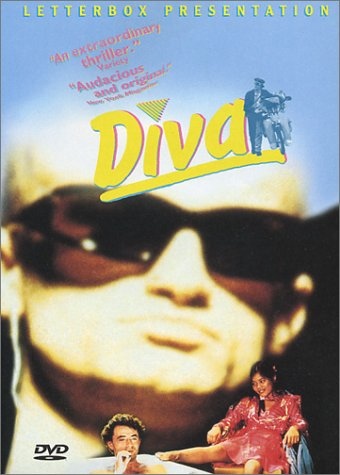
Director: Jean-Jacques Beineix
Starring: Frédéric Andréi, Roland Bertin, Richard Bohringer, Gérard Darmon, Chantal Deruaz
Genre: Art House & International
Studio: Fox Lorber Theatrical: 1982 Rated:
R
Languages (Country): French ()
Summary: Jean-Jacques Beineix ("Betty Blue") made a catchy debut as a director with this slick, defiantly superficial 1982 movie about a young mail carrier who illegally records a performance by an opera singer, then gets the tape mixed up with evidence that could incriminate gangsters. Wearing flashy commercialism like a badge, Beineix fills the screen with explosions of disposable pop kitsch. Yet he also tells a fairly compelling story in the process, a story that only seems to get more interesting the closer one gets to the end. An unusual experience, "Diva" should be seen also for the influence it had on the look and feel of movies and music videos in the '80s. "--Tom Keogh"

Director: Michael Almereyda
Starring: Ethan Hawke, Kyle MacLachlan, Diane Venora, Sam Shepard, Bill Murray
Genre: Art House & International
Studio: Theatrical: 2000 Rated:
R
Languages (Country): English ()
Summary: Perhaps the least important thing about this latest film version of Shakespeare's masterpiece is its setting in modern-day New York. Yes, such locales as the Guggenheim Museum are used wittily; answering machines and faxes are logically worked into the plot; and it was both inspired and entirely appropriate to make the prince of Denmark a moody, introspective filmmaker whose avant-garde collages provide the context for some of his famous monologues. All of which would be so much pleasantly humorous eye-candy if it didn't come hand in hand with a sympathy for and understanding of this remarkable cast of characters. For that, ultimately, is what makes Michael Almereyda's "Hamlet" such a delight to watch. Forget that the immortal rumination on suicide is placed in a Blockbuster Video aisle and notice instead how Ethan Hawke's own youthful, callow arrogance makes Hamlet's vacillations believable. And how the comical but infantilizing way Bill Murray's Polonius dotes upon his daughter Ophelia (Julia Stiles)--and her mute acceptance of his attentions--lead her to thoughts of a watery grave even before her bout of madness. And also notice how much Claudius truly does love Gertrude (when gazing at her, Kyle MacLachlan's face relaxes from its usual plasticity) and how Sam Shepard's ghost is less vengeful or tortured than stiffened by remorse. These are the shining moments of invention in Almereyda's bold updating of the play, and they are why this will be a film to watch and enjoy long after its setting has made it as much a period piece as Olivier's adaptation, with its broodingly lit castle, or Branagh's, with its gleaming 19th-century court. "--Bruce Reid"

Director: Jane Campion
Starring: Holly Hunter, Harvey Keitel, Sam Neill, Anna Paquin, Kerry Walker
Genre: Art House & International
Studio: Lions Gate Theatrical: 1993 Rated:
R
Languages (Country): English ()
Summary: Jane Campion's "The Piano" struck a deep chord (if you'll excuse the expression) with audiences in 1993, who were mesmerized by the film's rich, dreamlike imagery. It is the story of a Scottish woman named Ada (Holly Hunter), who has been mute since age 6 because she simply chose not to speak. Ada travels with her daughter Flora (Anna Paquin) and her beloved piano to a remote spot on the coast of New Zealand for an arranged marriage to a farmer (Sam Neill). She gives piano lessons to a gruff neighbor (Harvey Keitel) who has Maori tattoos on his face, and, well, things develop from there. The picture takes on a powerful dream logic that simply defies synopsis. It's a breathtakingly beautiful and original achievement from Campion, a unique stylist. "The Piano" won the Palme d'Or at the Cannes Film Festival and Oscars for Hunt, Paquin, and Campion's screenplay. "--Jim Emerson"
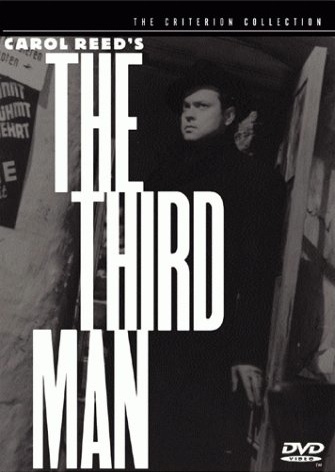
Director: Carol Reed
Starring:
Genre: Art House & International
Studio: Theatrical: 1933 Rated:
Languages (Country): English ()
Summary: The fractured Europe post-World War II is perfectly captured in Carol Reed's masterpiece thriller, set in a Vienna still shell-shocked from battle. Holly Martins (Joseph Cotten) is an alcoholic pulp writer come to visit his old friend Harry Lime (Orson Welles). But when Cotton first arrives in Vienna, Lime's funeral is under way. From Lime's girlfriend and an occupying British officer, Martins learns of allegations of Lime's involvement in racketeering, which Martins vows to clear from his friend's reputation. As he is drawn deeper into postwar intrigue, Martins finds layer under layer of deception, which he desperately tries to sort out. Welles's long-delayed entrance in the film has become one of the hallmarks of modern cinematography, and it is just one of dozens of cockeyed camera angles that seem to mirror the off-kilter postwar society. Cotten and Welles give career-making performances, and the Anton Karas zither theme will haunt you. "--Anne Hurley"